Waves Across Cultures
12 artists, one impossible problem
5 works
Navigator
Marcus
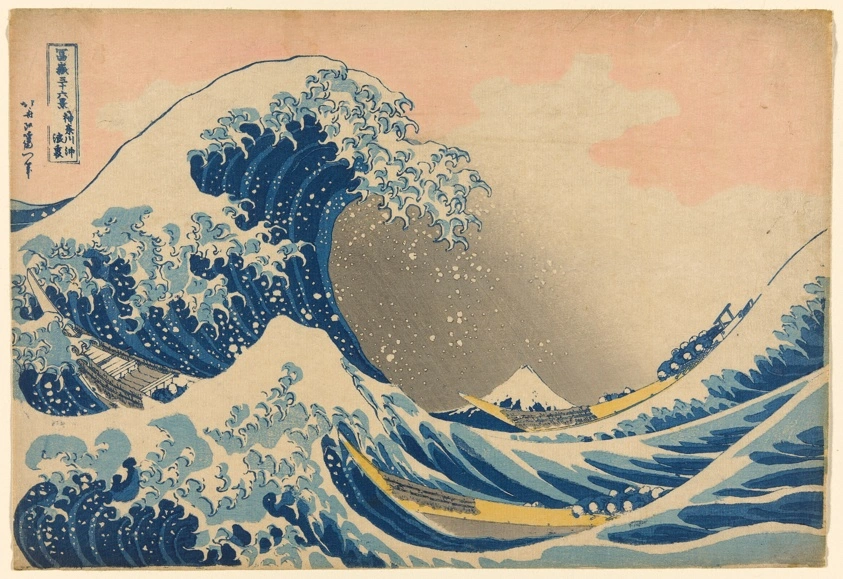
Under the Wave off Kanagawa (Kanagawa oki nami ura), also known as The Great Wave, from the series "Thirty-Six Views of Mount Fuji (Fugaku sanjurokkei)"
0:000:00
Waves Across Cultures
12 artists, one impossible problem
A cross-cultural curation of five paintings of the sea, from Hokusai's Great Wave to Aivazovsky's Russian Romantic seascape. Each artist solved the same impossible problem — how to hold moving water still on a flat surface — using radically different tools.
Artists from radically different traditions chose the wave as their subject and arrived at surprisingly convergent solutions. This curation lets the reader see those convergences in detail, not just read about them.
Under the Wave off Kanagawa (Kanagawa oki nami ura), also known as The Great Wave, from the series "Thirty-Six Views of Mount Fuji (Fugaku sanjurokkei)" 葛飾北斎
[Introduction] Katsushika Hokusai, a master of the late eighteenth and early nineteenth centuries, created the series Thirty-Six Views of Mount Fuji during the eighteen-thirties.This iconic print, known as The Great Wave, serves as the structural foundation for our exploration of the sea. [Visual Description] The composition is a monumental architecture of water, defined by deep sections of Prussian blue.Notice how the immense liquid curve dwarfs the three boats that struggle within the power of the sea.The foam is rendered as a geometric force, with claw-like crests that hold the moving water perfectly still. [Interpretation] Hokusai’s wave is built with mathematical precision, carefully framing the distant snow-capped Mount Fuji.The silhouette of the wave is often compared to a dragon, reflecting the duality of nature's destructive and creative power.This work established a global standard for capturing the movement of water on a flat plane. [Conclusion] This vision later reached Europe, influencing artists like Vincent van Gogh and Claude Monet.We now turn to a quieter Japanese perspective that emphasizes atmosphere over monumentality.
Maisaka: The Ferry at Imagiri (Maisaka, Imagiri funawatashi), from the series "Fifty-three Stations of the Tokaido (Tokaido gojusan tsugi)," also known as the Tokaido with Poem (Kyoka iri Tokaido) 歌川広重
[Introduction] Utagawa Hiroshige, often called the last great master of ukiyo-e, offers a different solution to the problem of water.This print from the Fifty-three Stations of the Tokaido depicts the ferry at Imagiri, framed by a red series title cartouche. [Visual Description] A white sail draws our eye to the foreground, where the dark hull of the ferry boat rests in the water.The composition uses these large foreground objects to create a profound sense of depth and scale.Beyond the ferry, a central strong mountain silhouette anchors the peaceful landscape. [Interpretation] Unlike Hokusai’s monumental wave, Hiroshige emphasizes atmosphere and the daily traffic of the sea.This focus on travel reflects the growth of Japanese transportation during the late Edo period.Hiroshige demonstrates that the Japanese vision of the ocean was never limited to a single style. [Conclusion] His work captures the calm harmony between human activity and the natural world.Moving forward, we see how these visual ideas reached the shores of nineteenth-century France.
Marine: The Waterspout Gustave Courbet
[Introduction] Gustave Courbet led the Realist movement in nineteenth-century France, rejecting Romantic styles to capture the world as it truly appeared.In this marine scene, a central waterspout connects the heavy sea to an expansive, stormy sky. [Visual Description] Notice the turbulent waves that seem to possess a physical, muscular weight against the towering cliffs.Courbet’s composition focuses on the raw materiality of the water, absorbing Japanese visual ideas through a French lens.The artist built his unique style by studying the masters at the Louvre instead of following academic traditions. [Interpretation] Courbet painted this as Japanese prints were flooding Paris, influencing how European artists perceived visible reality.He believed in painting only what he could see, turning the wave into a tangible fact of nature.This approach moved French painting away from literary themes and toward a more direct observation of the sea. [Conclusion] Born in Ornans, Courbet’s focus on the material world paved the way for the development of modernism.We now cross the Atlantic to see this influence evolve into something uniquely American.
Prout's Neck, Breaking Wave Winslow Homer American, 1836-1910
[Introduction] Winslow Homer produced this work in 1887 at his studio in Prout's Neck, Maine.It represents a synthesis of structural observation and modern American energy, featuring a large breaking white wave. [Visual Description] The turbulent deep green sea churns beneath a dark, heavy sky, capturing a sense of coastal weather.Notice how the water crashes against the foreground rocky shore, creating an abstract pattern of foam.Homer uses powerful colors and contrasts to express the raw strength of the Atlantic Ocean. [Interpretation] During this post-Civil War era, Homer’s focus turned toward the elemental forces of nature.His work assimilated both Hokusai’s structure and Courbet’s materiality into a new American vision.The wave here is both a documented fact of the Maine coast and a modern pattern of movement. [Conclusion] Homer, born in Boston, became one of the most significant landscape painters in American history.Our journey ends by returning to a final, grand vision of the Romantic sublime.
A Ship in a Stormy Sea Ivan Konstantinovich Aivazovsky (Hovhannes Aivazian)
[Introduction] Ivan Aivazovsky was a renowned marine master from the Russian Empire who produced this work in 1892.The painting depicts a ship struggling in the rough sea, returning the wave to the realm of the Romantic sublime. [Visual Description] On the left, a large swell rises with a crown of white spray, threatening to overtake the vessel.Observe the dramatic tilt of the ship as it battles the overwhelming power of the ocean.The dark shadow of the hull against the water emphasizes the depth and danger of the storm. [Interpretation] Aivazovsky created approximately six thousand works throughout his career, many inspired by his birthplace in Crimea.Though distant from the artistic circles of Paris, he arrived at formal solutions strikingly similar to his global contemporaries.The wave here is a universal problem that dictates its own form across all cultures. [Conclusion] We conclude with this ship, a symbol of human resilience preserved within the Metropolitan Museum of Art.The wave remains a timeless challenge, forever connecting artists through the shared rhythm of the sea.