What is it about the rhythmic movement of water that has held the human imagination captive for centuries? Across continents and eras, the sea has served as both a bridge and a barrier, a source of life and a harbinger of destruction. To stare into a painted wave is to confront our own existence: our resilience in the face of nature’s indifference, and our profound desire to map the unmappable.
In this exploration, we delve into five iconic maritime masterpieces that span the globe, from the woodblock prints of Edo-period Japan to the turbulent oils of 19th-century Europe and America. We will uncover how a single pigment changed the course of Japanese art, how a French realist defied tradition to capture a literal whirlwind, and why a Russian master became the undisputed poet of the storm.
By examining these "waves across cultures," we learn that while the ocean remains the same, the eyes that behold it see vastly different worlds. Whether it is the spiritual geometry of Hokusai or the raw, tactile realism of Winslow Homer, these works invite us to consider our place within the vast, blue expanse that covers our planet.
Under the Wave off Kanagawa (The Great Wave) by Katsushika Hokusai
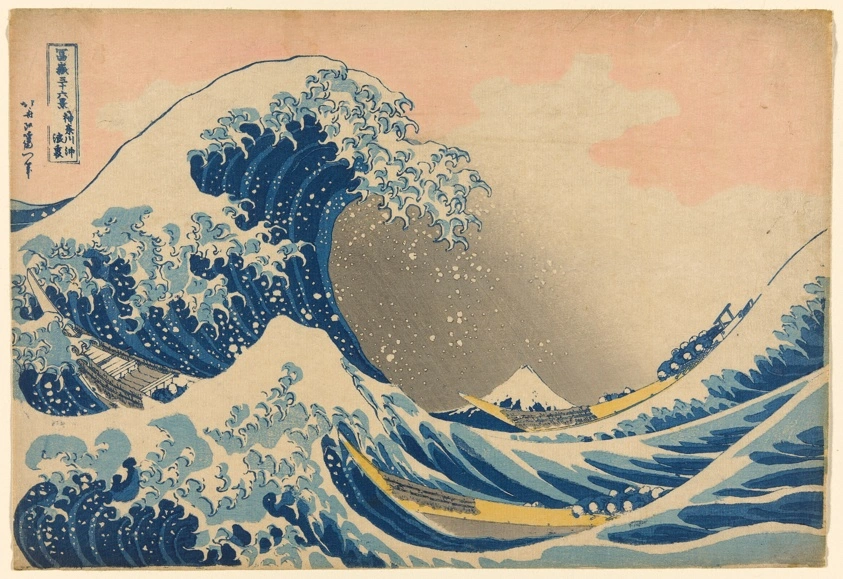
* Title: Under the Wave off Kanagawa (The Great Wave), from the series "Thirty-Six Views of Mount Fuji"
* Artist: Katsushika Hokusai
* Year: 1830/33
* Medium: Woodblock print; ink and color on paper
Learning Points: The Geometry of Nature
Katsushika Hokusai’s most famous work is a masterclass in composition and color. Produced during the late Edo period in Japan, it belongs to the series Thirty-Six Views of Mount Fuji[4]. The image is defined by a striking use of Prussian Blue—a synthetic pigment imported via Dutch traders that allowed for a depth and vibrancy previously unattainable with organic Japanese dyes.
Technically, the print utilizes a revolutionary perspective. While traditional Japanese art often employed a "bird's-eye" view, Hokusai adopted Western-style linear perspective to create a sense of dramatic depth[2]. This contrast between the towering, dynamic foreground wave and the small, static silhouette of Mount Fuji in the distance creates a tension that is central to the work’s enduring power.
Hidden Stories: The Dragon in the Foam
Beyond the literal depiction of a storm off the coast of Kanagawa, the work is steeped in philosophical symbolism. The churning water is often interpreted through the lens of Yin and Yang—the duality of life’s forces[3]. Curiously, many art historians have noted that the silhouette of the wave is not merely water; it echoes the form of a dragon, a recurring motif in Hokusai's later work that represents the untamable power of the natural world[5].
Viewing Tips: The Human Struggle
To truly appreciate the scale of this masterpiece, one must look closely at the oshiokuri-bune, the fast transport boats used to carry live fish to market.
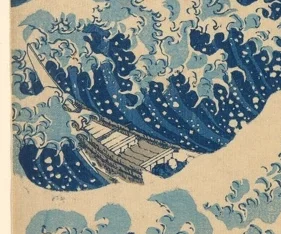
On the left side of the print, the rowers huddle together, their bodies mimicking the curve of the boat as they surrender to the sea's will. This detail emphasizes the fragility of human endeavor against the monumental force of the wave[1].
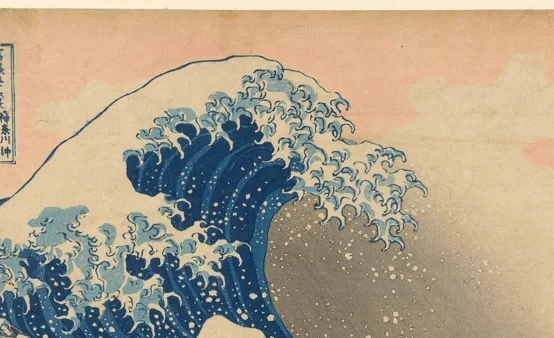
Notice the claw-like crest of the wave. These fractal-like extensions make the water feel sentient, as if it is reaching out to grasp the sailors. Finally, find the snow-capped Mount Fuji nestled within the hollow of the wave.
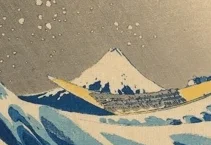
Despite the chaos surrounding it, the mountain remains perfectly calm, serving as a spiritual anchor for the entire composition.
Maisaka: The Ferry at Imagiri by Utagawa Hiroshige
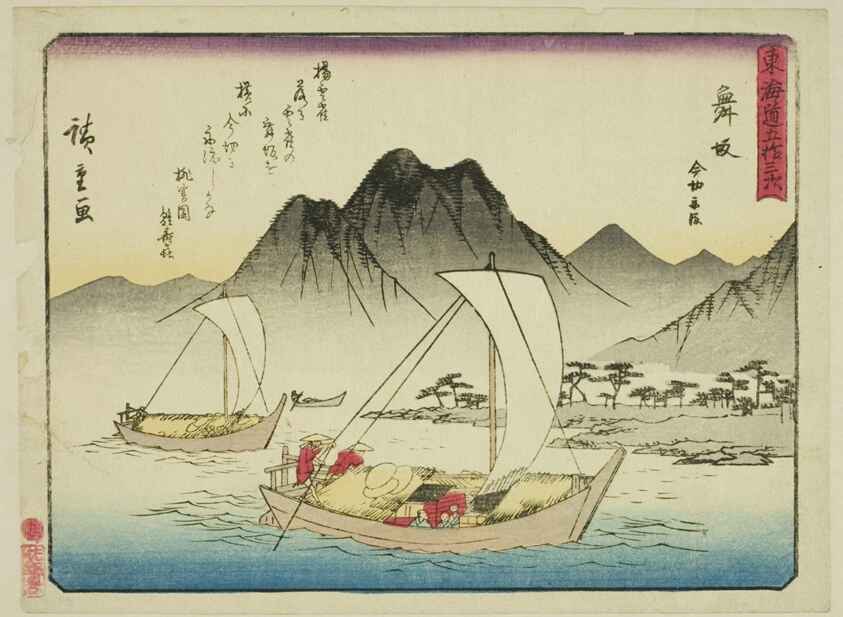
* Title: Maisaka: The Ferry at Imagiri, from the series "Fifty-three Stations of the Tokaido"
* Artist: Utagawa Hiroshige
* Year: c. 1837/42
* Medium: Woodblock print; ink and color on paper
Learning Points: The Poetry of the Road
If Hokusai was the architect of the sea, Utagawa Hiroshige was its poet. This print is part of his celebrated Fifty-three Stations of the Tokaido series, which documented the journey along the coastal road connecting Edo (Tokyo) to Kyoto[8]. During the late Edo period, internal travel became a popular pastime as infrastructure improved[6].
Hiroshige’s style is characterized by a "lyrical" atmosphere. Unlike the terrifying power of Hokusai’s wave, Hiroshige focuses on the atmospheric quality of the water and the mundane reality of travel. The blue rippling surface of the water is achieved through a technique called bokashi (gradation), where the printer carefully wipes the woodblock to create a soft transition of color[10].
Hidden Stories: A Snapshot of History
This particular scene depicts the ferry crossing at Imagiri in Maisaka. Hiroshige, who lived from 1797 to 1858, was known for his ability to infuse landscape prints with a sense of season and time of day[7]. Interestingly, this specific edition includes a kyoka (humorous poem), which was a common feature in prints intended for a literate, urban audience who enjoyed the cultural associations of the places depicted[9].
Viewing Tips: The Balance of the Horizon
The composition is anchored by a central mountain silhouette, which provides a sense of depth and distance.
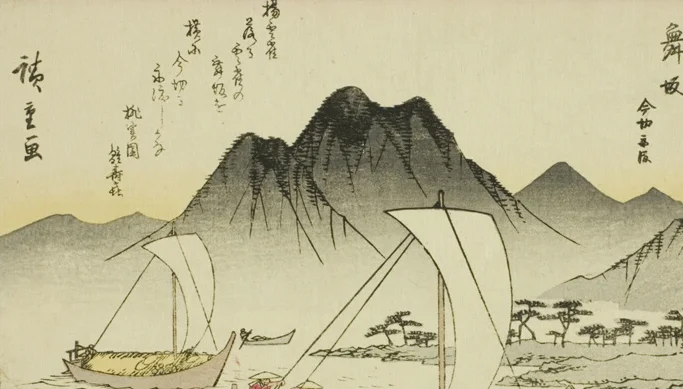
In the foreground, observe the white sail of the boat. Its starkness against the blue water draws the eye immediately to the human element of the scene.
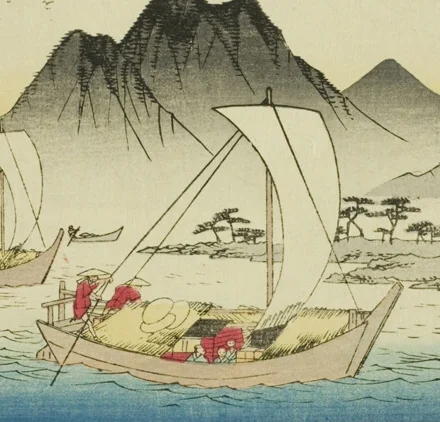
Finally, look for the artist's signature on the left side, which reads "Hiroshige ga" (pictured by Hiroshige).

This placement, along with the red title cartouche, was a standard branding method for ukiyo-e publishers in the 19th century.
Marine: The Waterspout by Gustave Courbet
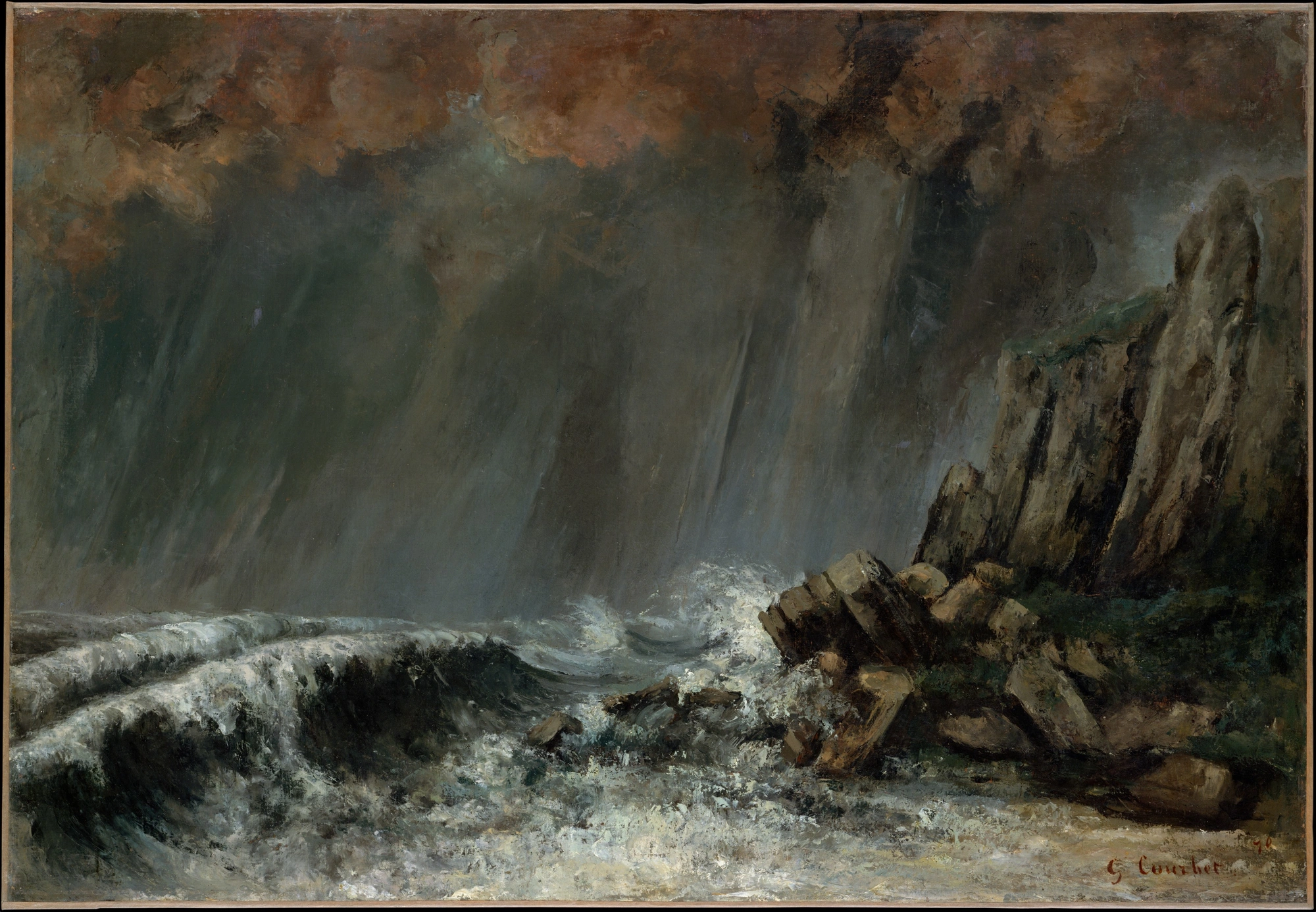
* Title: Marine: The Waterspout
* Artist: Gustave Courbet
* Year: 1870
* Medium: Oil on canvas
Learning Points: The Birth of Realism
Gustave Courbet was a provocateur who fundamentally changed French painting. By rejecting the idealized, dramatic scenes of Romanticism, Courbet paved the way for Realism[11]. In Marine: The Waterspout, he treats the ocean not as a stage for human drama, but as a physical, material reality.
Courbet’s technique was revolutionary; he often used a palette knife rather than a brush to apply thick layers of paint (impasto). This gives the water and rocks a tactile, "built" quality. He led the Realist movement in 19th-century France, insisting that artists should only paint what they could see and touch[13].
Hidden Stories: Art in Exile
The year 1870 was a turning point for Courbet. Shortly after painting this work, his involvement in the Paris Commune led to his imprisonment and eventual exile to Switzerland, where he remained until his death in 1877[12] [14]. Throughout his life, Courbet maintained a deep connection to the rugged landscapes of his home region, Franche-Comté, and he brought that same appreciation for raw, unpolished nature to his seascapes[15].
Viewing Tips: The Materiality of the Storm
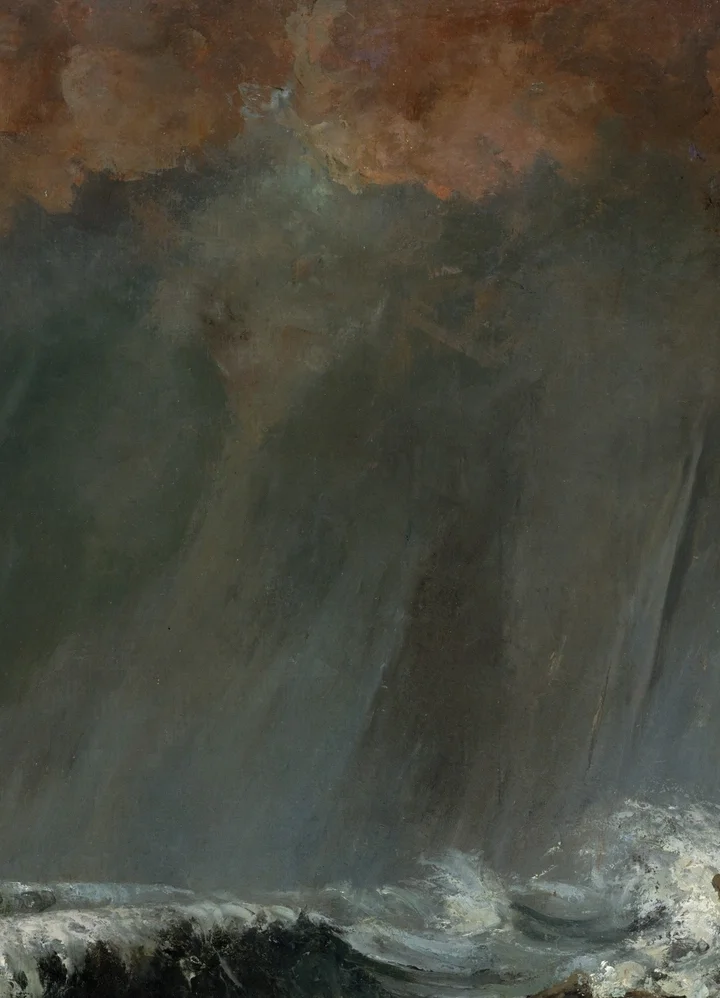
The focal point of the painting is the central waterspout, a rare meteorological phenomenon that connects the dark sky to the churning sea.
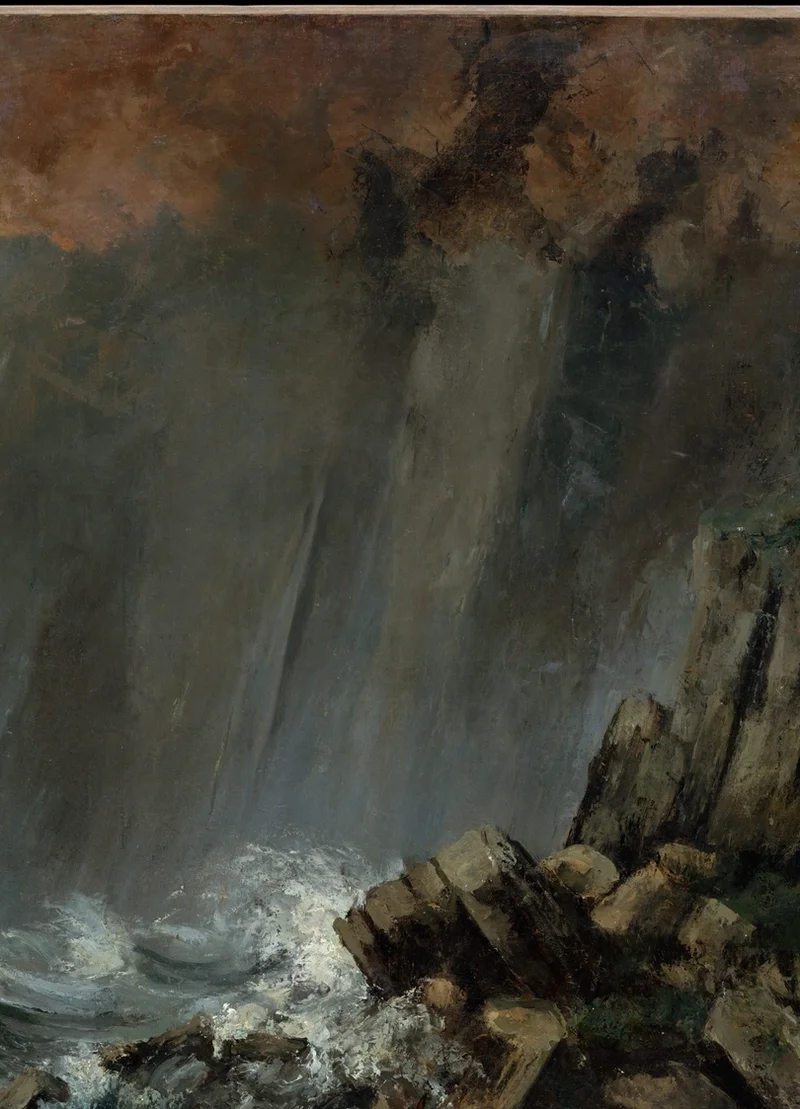
Rather than painting it with soft, ethereal strokes, Courbet uses heavy, vertical marks to suggest its immense power. Look at the wave spray crashing on the rocks in the foreground.
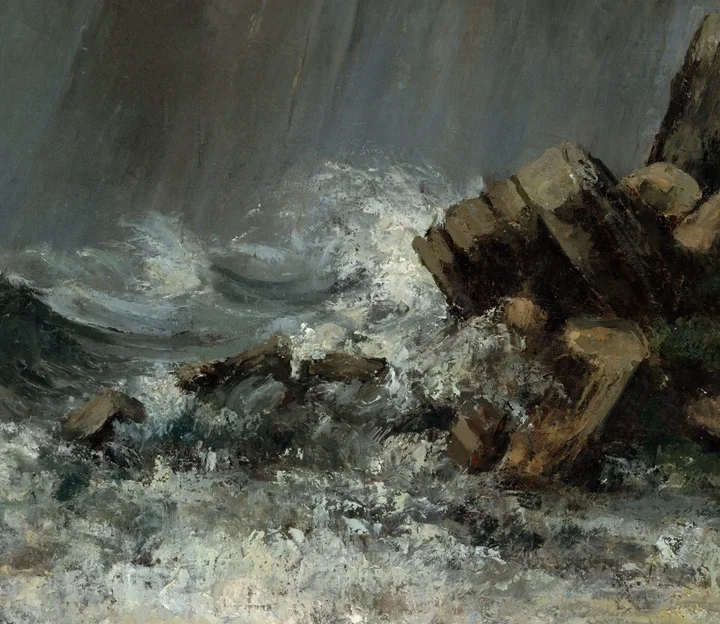
The white paint is applied so thickly that it seems to physically protrude from the canvas, mimicking the chaotic energy of the foam. Finally, observe the streaks of falling rain in the background, which blur the boundary between the sea and the stormy sky.
Prout's Neck, Breaking Wave by Winslow Homer
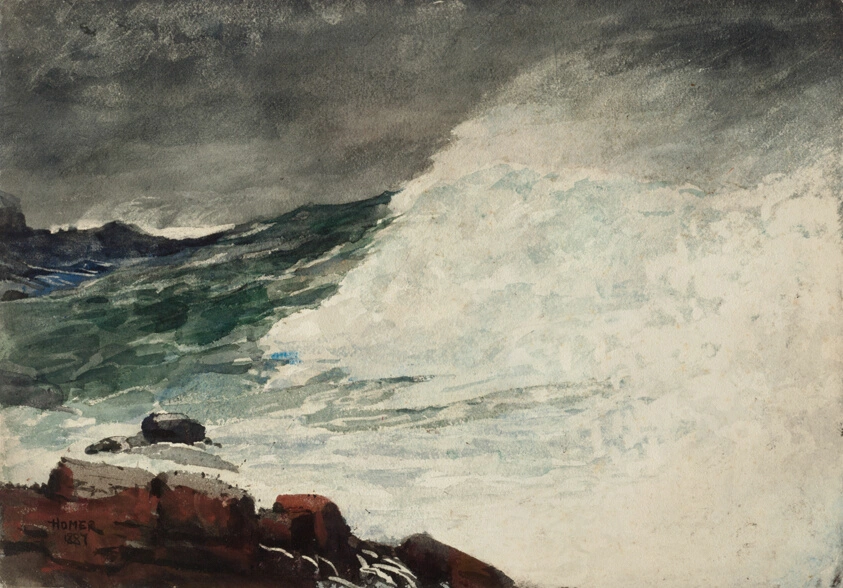
* Title: Prout's Neck, Breaking Wave
* Artist: Winslow Homer
* Year: 1887
* Medium: Watercolor and touches of gouache, over graphite, on off-white wove paper
Learning Points: The American Coast
Winslow Homer is perhaps the most iconic chronicler of the American maritime spirit. Born in Boston in 1836, he began his career as an illustrator before becoming a master of both oil and watercolor[20]. This work, Prout's Neck, Breaking Wave, was created at a time when America was rapidly industrializing following the Civil War[18].
Homer’s approach to watercolor was exceptionally bold. He used strong colors and high contrast to capture the "play of light" on the water's surface[16]. Unlike European traditions that often favored a more finished look, Homer’s watercolors retain a sense of immediacy and spontaneity, echoing the fleeting nature of the waves themselves.
Hidden Stories: The Hermit of Maine
In 1883, Homer moved to Prout's Neck, Maine, where he built a studio overlooking the Atlantic Ocean[19]. He lived there in relative isolation, becoming obsessed with the raw power of the sea. It was here that he produced his most profound marine works, often going out during storms to witness the water at its most violent[17]. He remained at Prout's Neck until his death in 1910, having transformed the rugged Maine coastline into a symbol of the American character[20].
Viewing Tips: The Texture of the Tide
Focus on the large breaking white wave that dominates the center of the composition.
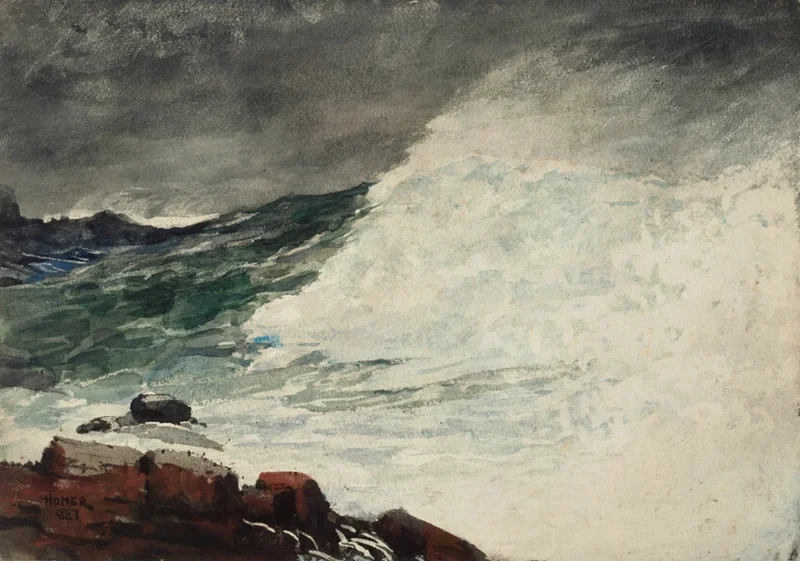
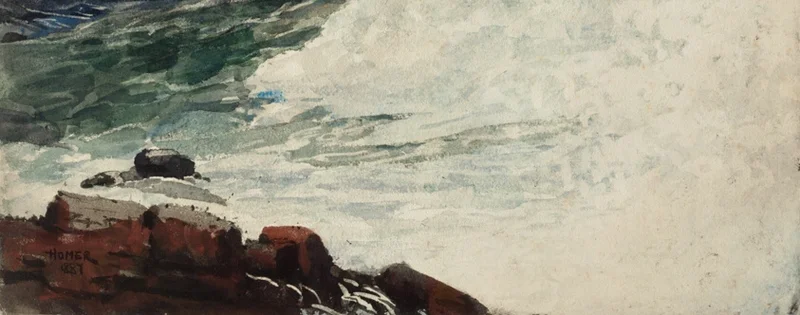
Homer leaves parts of the paper white or uses light washes to suggest the transparency of the water. Below the crest, notice the turbulent deep green sea.
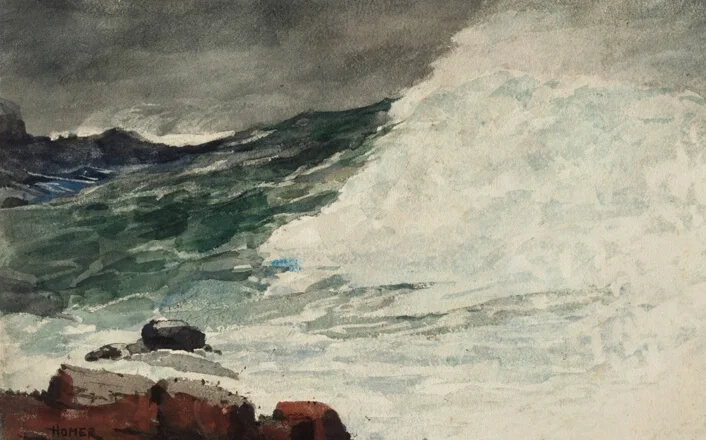
The dark, moody tones suggest depth and danger. In the foreground, the rocky shore is rendered with jagged, dark strokes, providing a solid, unyielding contrast to the fluid motion of the water.
A Ship in a Stormy Sea by Ivan Konstantinovich Aivazovsky
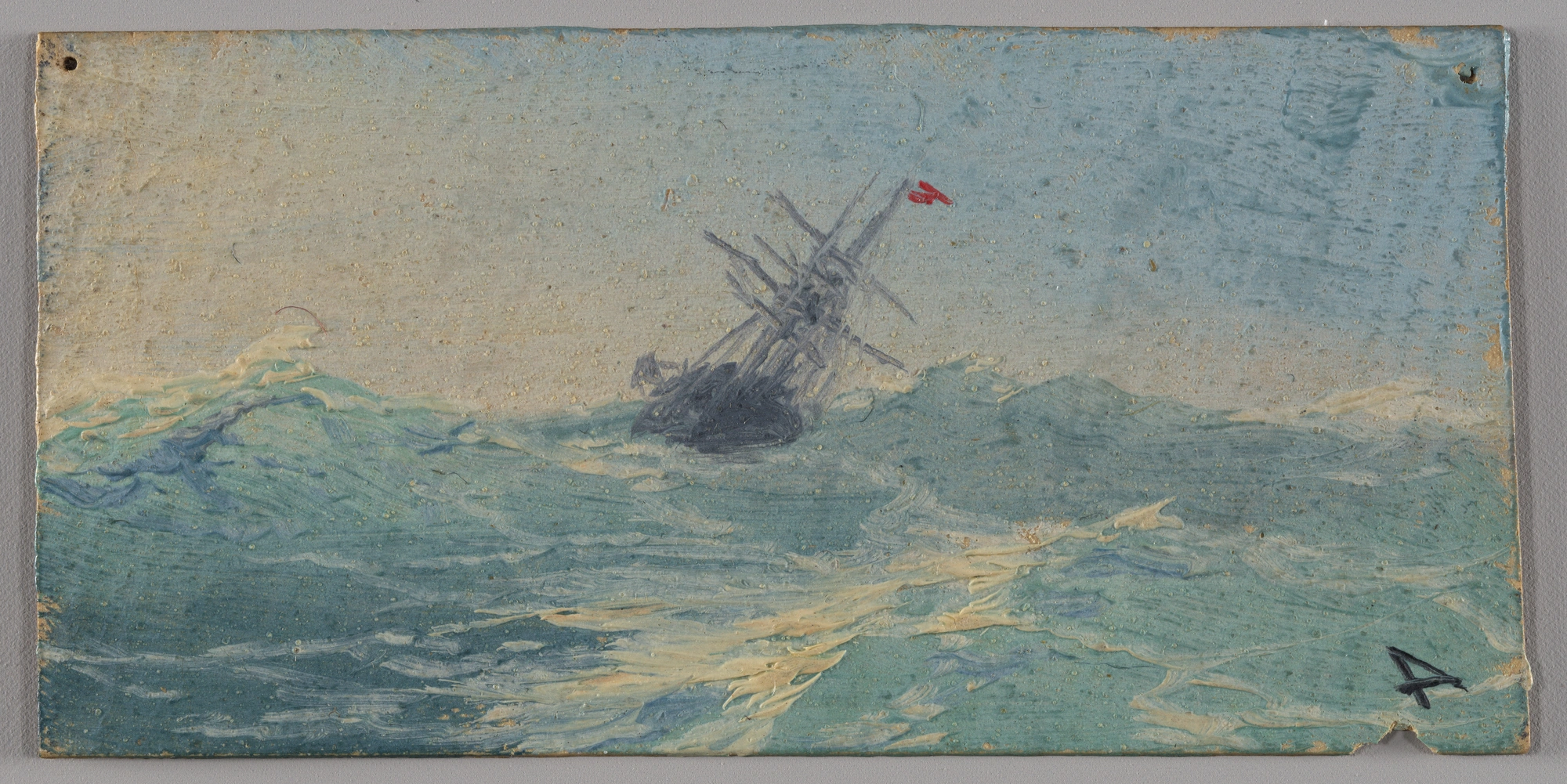
* Title: A Ship in a Stormy Sea
* Artist: Ivan Konstantinovich Aivazovsky (Hovhannes Aivazian)
* Year: 1892
* Medium: Oil on canvas
Learning Points: The Sublime Storm
Ivan Aivazovsky was the premier marine painter of the Russian Empire. Born in the Crimean port city of Feodosia, he spent his childhood on the shores of the Black Sea, which would become his lifelong muse[25]. A Ship in a Stormy Sea is a quintessential example of the "Sublime"—a style that emphasizes the overwhelming power of nature and the feelings of awe and terror it inspires.
Aivazovsky was legendary for his ability to paint from memory. He rarely worked from direct observation of the sea, claiming that "the motion of the elements cannot be captured by the brush from life"[22]. His technique involved layering thin glazes of oil paint to create a luminous, translucent effect, particularly in the crests of waves where light filters through the water.
Hidden Stories: A Global Artist
While deeply rooted in the Black Sea region, Aivazovsky was a world traveler. In 1892, the same year this painting was completed, he visited the United States[21]. This work is currently housed in the Metropolitan Museum of Art in New York, a testament to his international acclaim during his lifetime[23]. Despite his fame, he remained loyal to his hometown, where he founded an art school and gallery that still exist today[25].
Viewing Tips: The Drama of the Deep
The narrative heart of the painting is the ship struggling in the rough sea.
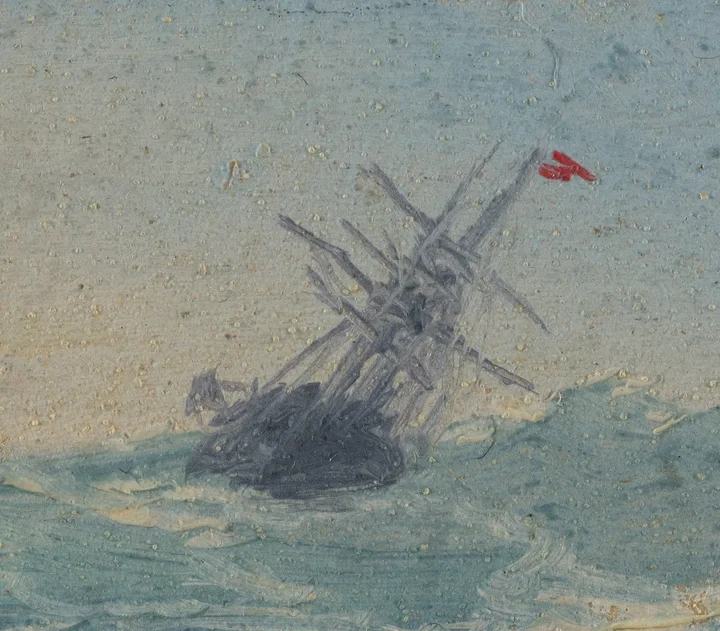
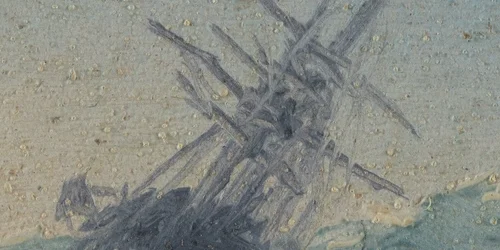
Observe the extreme tilt of the ship and the tilted masts, which convey the violence of the storm and the imminent danger to the crew.
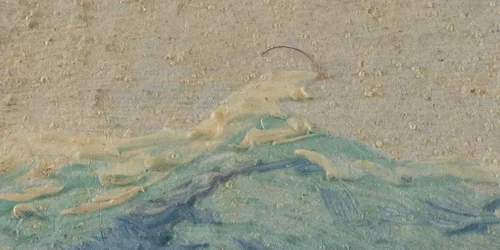
Look at the white spray on the wave crest in the foreground. Aivazovsky’s ability to render the "soul" of the water is evident in how the light seems to glow from within the wave itself.
Finally, notice the light reflection on the water surface, which suggests a break in the clouds, offering a flicker of hope amidst the darkness.
Conclusion: The Eternal Recurrence of the Wave
From the calculated geometry of Hokusai to the memory-driven drama of Aivazovsky, these five masterpieces demonstrate that the sea is more than just a geographical feature; it is a mirror for the human condition. In Japan, the wave was a symbol of cosmic balance and national identity. In France, it became a manifesto for Realism and a witness to political exile. In America, it represented the rugged, solitary confrontation between man and the frontier.
Despite their different techniques and cultural contexts, these artists all grappled with the same fundamental challenge: how to capture a subject that is never still. They remind us that nature is both beautiful and terrifying, and that our attempts to frame it in art are our way of making sense of a vast, often overwhelming world.
As you look back at these waves, ask yourself: In the face of nature's overwhelming power, do you see a force to be feared, or a beauty to be surrendered to?
Listen to These Artworks with Audio Guide
The artworks featured in this article are also available as audio guides on artible.
Experience the feeling of standing before each masterpiece with thoughtful narration.
Listen to "Waves Across Cultures"
References
Sources
[1] The Great Wave off Kanagawa - Wikipedia
[2] The Great Wave off Kanagawa - Wikipedia
[3] The Great Wave off Kanagawa - Wikipedia
[4] The Great Wave off Kanagawa - Wikipedia
[5] The Great Wave off Kanagawa - Wikipedia
[6] Art Institute of Chicago - Maisaka
[7] Art Institute of Chicago - Maisaka
[8] Art Institute of Chicago - Maisaka
[9] Art Institute of Chicago - Maisaka
[10] Art Institute of Chicago - Maisaka
[11] Gustave Courbet - Wikipedia
[12] Gustave Courbet - Wikipedia
[13] Gustave Courbet - Wikipedia
[14] Gustave Courbet - Wikipedia
[15] Gustave Courbet - Wikipedia
[16] Art Institute of Chicago - Prout's Neck
[17] Winslow Homer - Britannica
[18] Winslow Homer - Wikipedia
[19] Winslow Homer - Britannica
[20] Winslow Homer - Wikipedia
[21] Metropolitan Museum of Art - Aivazovsky
[22] Wikimedia Commons - A Ship in a Stormy Sea
[23] Metropolitan Museum of Art - Aivazovsky